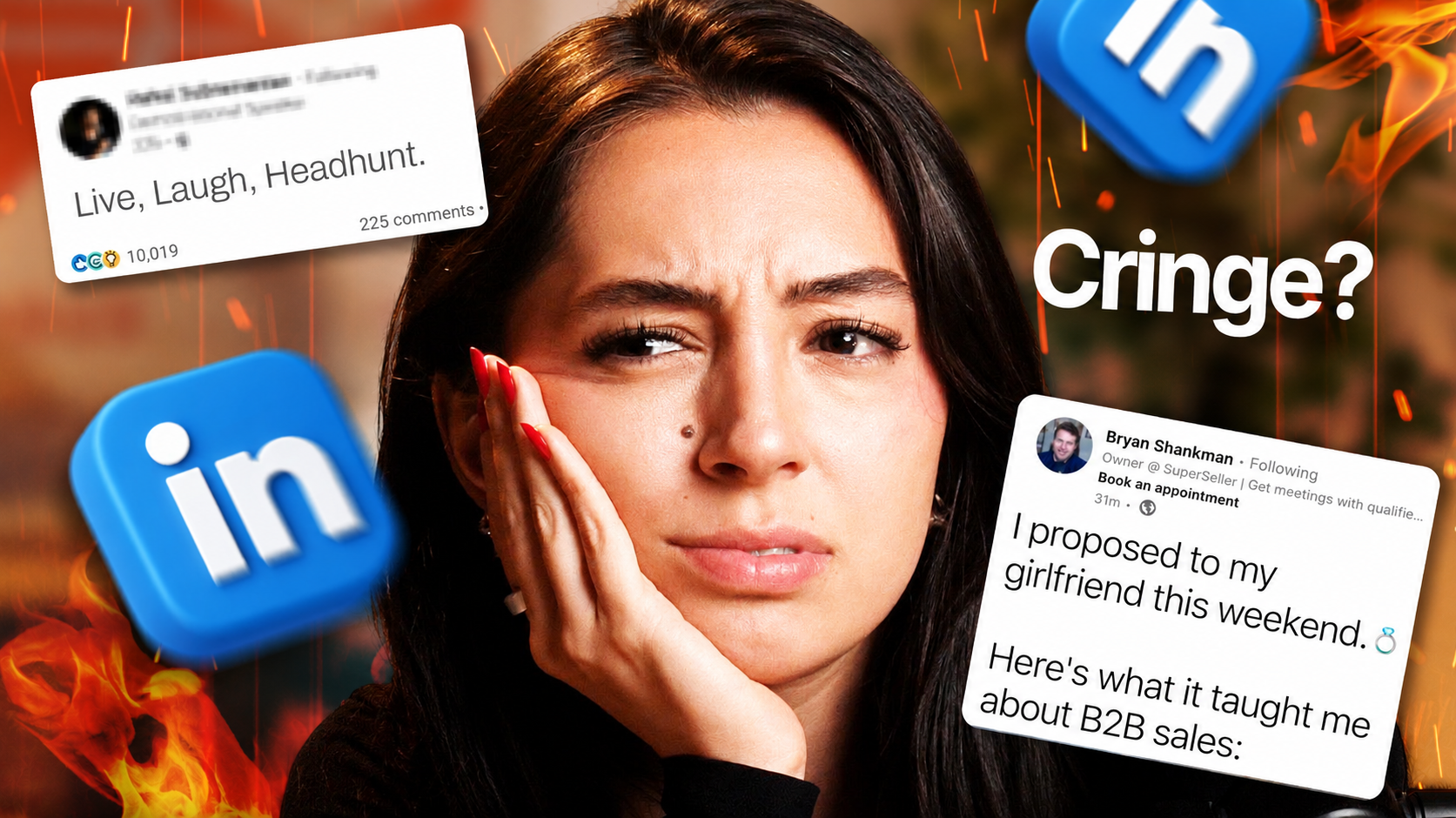
Is LinkedIn cringe? Parts of it, yes. The corporate bros, the fake crying about morning routines, the guy who almost quit everything until his four-year-old said something profound over breakfast. That layer exists. Writing off the whole platform because of it is still the most expensive mistake a B2B founder can make right now, because underneath the noise there’s a layer of operators using LinkedIn to close deals, get inbound from companies they never cold called, and build audiences that pay them.
I’m Diandra Escobar. I built Distinctiva, a B2B content agency, to six figures in year one through inbound LinkedIn content and zero cold outreach. I’ve watched the LinkedIn Lunatics screenshots. I’ve laughed at the TikToks. And I’ve watched the people laughing keep grinding with zero inbound while the people they’re laughing at fill their calendars.
This piece is the other side. What the cringe reputation gets right, what the authority paradox is, who’s winning on LinkedIn with no shoulder pads involved, and how you show up there without turning into the thing you’re making fun of.
Why does LinkedIn feel so cringe?
Because for years the platform rewarded performance over substance, and the format became a meme.
You know it. Every sentence on its own line. The dramatic pause before the lesson. “I almost gave up, but then I remembered why I started,” written by someone who never built anything. The fake meritocracy, the hustle cosplay, the ChatGPT wisdom wrapped in a personal story that never happened.
A creator I like recently did a full breakdown of a LinkedIn influencer pulling 60 million views a month. The shoulder pads, the “billionaire, millionaire, normal people” bit, lying to a recruiter framed as breaking the rules. The takedown was fair and it was funny.
Then there’s the LinkedIn Lunatics subreddit, a community of hundreds of thousands of people whose entire entertainment is screenshotting the most unhinged posts on the platform. There’s a whole genre of TikToks and Reels doing the same thing.
So the reputation is earned, at least partly. The problem is what people do with it. They take the worst examples of a platform and let those decide whether they participate. Every platform has a cringe layer. Instagram has it, YouTube has it, X is nothing but it some days. Nobody refuses to use email because spam exists.
What is the authority paradox?
The authority paradox is this: the people who mock LinkedIn the hardest tend to be the ones who need it most.
They want inbound. They want to be seen as the expert in their space. They want their name to mean something in their industry, and they’ve earned it, because they’re doing real work. But posting feels embarrassing. It feels cringe. So they stay invisible.
Meanwhile someone with the same credentials, or fewer, and the same knowledge, or less, starts posting consistently. Six months later that person is a name everyone in the space knows. They weren’t smarter. They showed up.
Visibility is a prerequisite for authority. You can be the best in your field and if nobody can find you, the referral goes to the person they can find. And right now LinkedIn is one of the highest-return places to build that visibility, for one structural reason.
LinkedIn is the only platform where a single post reaches a buyer
Instagram is lifestyle. YouTube is broad. X is chaotic. LinkedIn is where professional decisions get made.
It’s the one platform where you can reach a VP of engineering, a CMO, or a Series B founder organically with a single post. No paid ads, no massive following required. There are 1.3 billion people on LinkedIn and only 3% of them post anything, which means the feed is starving for people who know what they’re talking about.
That’s the math the LinkedIn haters skip. The cringe is real. The buyers are also real, and they’re scrolling past the cringe looking for someone worth talking to.
Who is winning on LinkedIn without being cringe?
Two people who made me want to write this.
Adam Robinson
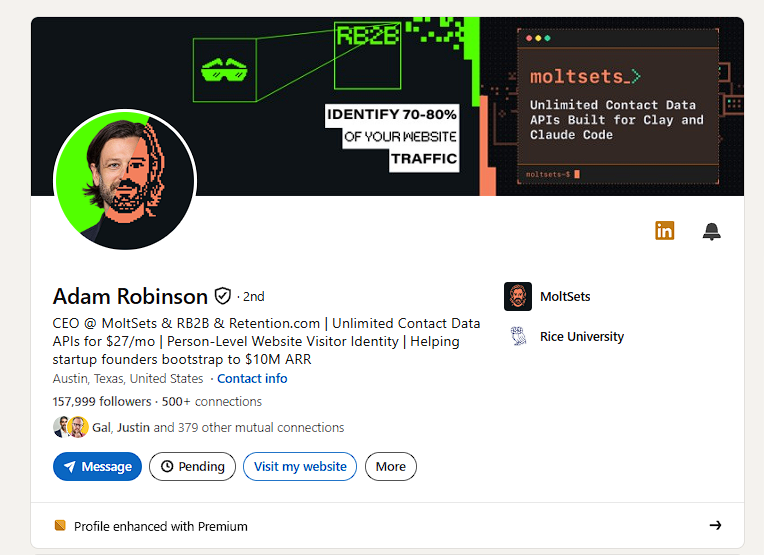
CEO of two companies. Bootstrapped Retention.com from zero to $22 million ARR in four years with no funding. 153,000 followers.
His posts are full breakdowns of how to run ABM in 2026 without burning $100K on enterprise software. Zero motivational fluff about his morning routine. Specific frameworks, real tools, stuff you can use the same afternoon, delivered with personality and zero corporate speak. He posts like an operator because he is one.
Bejay Mulenga MBE
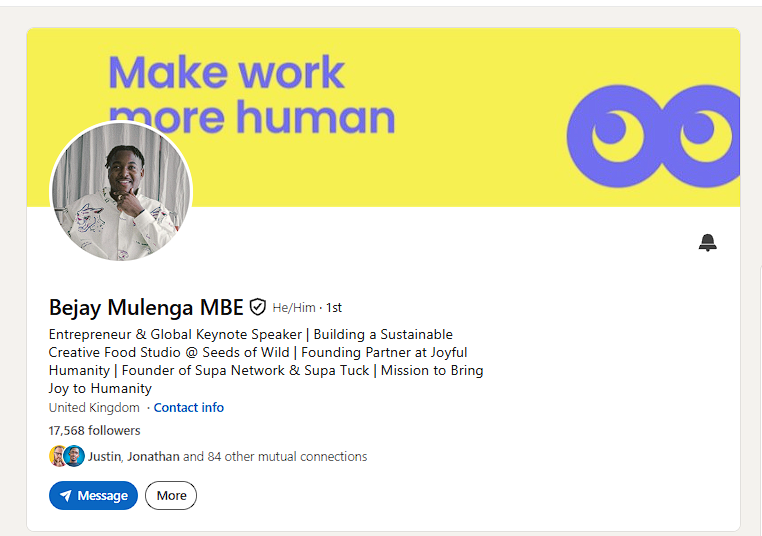
I met Bejay at an event in Steven Bartlett’s office in London. He has an MBE. He’s worked with Google, Apple, Samsung, Canva, and Alibaba. He’s been building businesses since he was 15.
Someone with that résumé has started posting on LinkedIn again, consistently. He wrote in a recent post that his “mini personal brand” opened doors for him with no agent and no talent rep, and that 15 years of showing up as himself is what created the connections behind those brand deals.
That’s the authority paradox in action. You can have the MBE, the blue-chip clients, the studio, all of it, and there are still doors that only open when people already know your name before you walk in. If someone at that level is leaning into LinkedIn harder, the excuse for everyone else gets thin.
What does this look like for Distinctiva clients?
The public examples are nice. Here’s what it looks like when we build it for someone.
The founder who was invisible to his own investors
Client one is the founder of a 200-person, AI-native software development agency, and a partner at a VC firm. Strong reputation inside his network. Zero LinkedIn presence when he came to us. Everything ran on referrals.
He sits at a rare intersection: operator at one of the most respected dev agencies for venture-backed startups, and an investor evaluating those same founders from the other side of the table. Nobody outside his immediate circle knew that.
Within months his content was getting shared between investors and partners on its own. His own investors started sending his posts to their networks. He became the obvious expert for the exact founders he’s both building for and investing in, and the referrals that used to arrive by luck now arrive because people saw him first.
The SEO expert with no YouTube channel
Client two is the brand advocate at one of the most respected SEO companies in the world. Massive technical expertise. Quiet personal LinkedIn, and the company had no YouTube presence at all.
We built the YouTube channel from scratch and rebuilt his LinkedIn. His following grew past 35,000. The company now has a live, active channel, and he’s one of the most recognizable faces in the SEO space.
The agency that tripled on LinkedIn alone
One more, because this one has the number the skeptics ask for. An SEO agency client grew from $1.2M to $3.6M ARR on a system we built. Over 80% of that pipeline came from LinkedIn. Zero outbound.
None of these people post cringe. No shoulder pads, no crying selfies, no lessons from a toddler. They show up with clarity, consistency, and a real point of view, and the business follows.
How does the LinkedIn flywheel work?
The part most people outside LinkedIn don’t understand is the compounding. I call it the flywheel.
When you post on LinkedIn, your reach is bigger than your follower count. Every time someone engages, their network sees the post too. One comment from the right person can put your content in front of 50,000 people who’ve never heard of you.
The haters see the post. They don’t see the DM that came in three days later. The intro that turned into a partnership. The speaking invite that came from a post with 200 likes or fewer. From the outside, the ROI is invisible, which is exactly why the outside keeps laughing.
The window closes when everyone catches on
We’ve watched this on every platform. The people who moved early on Instagram and YouTube have advantages today that are close to impossible to replicate, because the moment everyone shows up, organic reach contracts.
LinkedIn is in that window right now. Three percent of 1.3 billion people are posting. The feed is not full. It will be.
How do you post on LinkedIn without being cringe?
This is the part the video skips and the part people ask me about most, so here’s what we do with clients at Distinctiva. Every one of the people above follows some version of it.
Write about the work, not the feelings about the work
The cringe layer runs on emotion with no substance underneath. A founder crying about a hard year with nothing to show for it reads as performance. The same founder explaining what broke, what they changed, and what the number looked like after reads as an operator. Adam Robinson’s ABM breakdowns are the model. Teach the thing you’d teach a new hire on day one.
Take one position per post
A post that gestures at three opinions argues none of them. Pick one claim someone in your industry could disagree with, argue it, and stop. Posts that try to please everyone are the ones that read as AI, because AI is trained to please everyone.
Drop the arc
The “I almost quit, then I remembered why I started” story is a template, and your buyers have seen it a thousand times. Tell them what happened in the order it happened and skip the moral. Real experience rarely arrives in a crisis, revelation, transformation shape anyway.
Show up for people before you post for people
I started posting on LinkedIn at 22 with zero clients and zero proof. The most useful thing I owned was a feed full of people already doing what I wanted to do, so I showed up in their comments, then their DMs. Some of those DMs became calls, and some of those calls became clients, partners, and the people I now travel with. Every client Distinctiva has ever signed traces back to a specific person I decided to talk to first. Comments compound faster than posts do when nobody knows you yet.
Give every post a job
At Distinctiva we split content into four buckets: Growth (new eyes), Authority (trust and proof), Conversion (one clear action), and Personal (the human behind the work). Most cringe is Personal content with no Authority underneath it. Run the mix and the Personal posts stop feeling like oversharing, because they sit next to proof.
Be consistent in a way you can sustain
The founder who built an audience in six months posted through the weeks nothing happened. That’s the whole difference between them and the person who posted daily for three weeks and vanished. One long-form piece a week, cut into eight shorter pieces, is more sustainable than trying to be clever five times a day. That’s the 1:8 repurposing ratio we run for every client.
So who’s being delusional?
The founder posting a lesson from a hard year is fine. Even the clumsy version of that post is doing more for their business than silence.
The delusion is the founder watching that post, rolling their eyes, and going back to cold email. It’s spending $5,000 or more a month on ads before ever testing whether organic authority could get there first and last longer. It’s waiting until you have 10,000 followers to take LinkedIn seriously, when every person with 10,000 followers started with zero.
Yes, LinkedIn has cringe content. Every platform does. Letting the worst version of something decide whether you participate is how you hand your competitors a head start they’ll never give back.
The only question that matters is where your buyers are and whether you’re showing up there. For B2B founders, executives, consultants, and agencies, the answer is LinkedIn every single time.
What to do with this
Post about the work you’re already doing, take one side per post, and show up in other people’s comments before you expect them to show up in yours. Do that for six months and the memes stop mattering, because the DMs don’t come from the people making them.
If you’d rather have it built for you, that’s what we do at Distinctiva. We work with founders, CMOs, and operators to build the whole content engine: LinkedIn, YouTube, newsletter, strategy, writing, design, posting, and engagement, run by our team so you can run your business. Book a call and we’ll figure out what your content is missing.
If you’re not ready for done-for-you, I run a community called The LinkedIn Engine. Founders, operators, consultants, and small business owners come there to build this themselves, with live calls every week, profile audits, and the same content frameworks we use with agency clients. Come build with us.
Frequently asked questions
Is LinkedIn worth it for B2B founders in 2026?
Yes. LinkedIn is the only platform where a single organic post can reach a VP, a CMO, or a funded founder without paid ads or a large following. With 1.3 billion users and only 3% posting, the people who show up consistently with real expertise get found by buyers looking for them.
What is the authority paradox on LinkedIn?
The authority paradox, a term Diandra Escobar uses at Distinctiva, describes how the professionals who mock LinkedIn the most are usually the ones who need it most. They have the expertise and want the inbound, but posting feels embarrassing, so they stay invisible while less qualified people build the reputation instead.
How do you post on LinkedIn without sounding cringe?
Write about your actual work instead of your feelings about it, take one clear position per post, skip the crisis-to-revelation story template, and spend time in other people’s comments before expecting engagement on your own. Consistency over six months matters more than any single post.
How long does it take to see results from LinkedIn content?
Distinctiva clients typically see their content being shared inside their target network within months of posting consistently. One client grew a following past 35,000 in about a year, and an SEO agency client grew from $1.2M to $3.6M ARR with over 80% of pipeline from LinkedIn and zero outbound.
Should I run LinkedIn ads before building organic content?
Test organic authority first. Ads stop working the moment you stop paying, while a body of organic content keeps generating DMs, intros, and speaking invites long after it’s posted. Spending $5,000 a month on ads before testing organic is one of the most common expensive mistakes B2B founders make.