The new LinkedIn algorithm rules: 8 fixes for 2026
Sep 02, 2026
LinkedIn rebuilt its feed on a fine-tuned LLM. Eight rules changed, plus what to fix on your profile and your posts this week.
Diandra Escobar
Content Manager
Share:
What's covered:
LinkedIn rebuilt the system that decides who sees your posts. Retrieval now runs on a fine-tuned large language model, ranking runs on a transformer that reads your engagement history as a sequence, and only five profile fields travel with your content into someone else’s feed. Eight things about what works changed with it.
None of this is guesswork. It comes from LinkedIn’s own research papers, a technical breakdown on their engineering blog, an official corporate announcement, and a public post from the VP of Engineering who spent 13 years building the feed.
Most people are still running advice built for the old system. Post at 8am. Get the pod to comment in the first ten minutes. Stack the hashtags. Those tactics worked because they were aimed at simple machines that no longer exist.
At Distinctiva we run LinkedIn for founders, CEOs, CMOs and heads of growth, so we watch this land across a lot of accounts at once. One SEO agency client went from $1.2M to $3.6M ARR on the system we built, with over 80% of pipeline coming from LinkedIn and zero outbound. Below is what changed, and the specific thing to go fix after each rule.
What LinkedIn actually rebuilt
For years LinkedIn ran several separate retrieval systems at the same time. One tracked your network’s activity chronologically. One handled trending posts by geography. One ran collaborative filtering across similar members. Another tracked industry-specific trending content, and several more ran on embeddings.
Each of those had its own infrastructure, its own logic and its own blind spots. That’s the real reason the old hacks worked. You were gaming individual machines, and the machines were simple enough to trick.
LinkedIn is replacing all of that with a single retrieval model powered by a fine-tuned version of Meta’s Llama 3. On top of it sits a new ranking model, a generative recommender using transformer architecture to understand how you consume content over time.
This is a ground-up rebuild of both halves of the feed: how content gets discovered, and how it gets ranked.
Where the information comes from
Earlier this year a paper described a 150-billion parameter model called 360Brew, built to unify LinkedIn’s ranking systems. It came down off arXiv for licensing reasons shortly after it went up.
In October 2025 a second paper landed from LinkedIn’s own team describing the rebuilt retrieval system, written by LinkedIn engineers, published from their LinkedIn.com addresses, with real A/B test data from the live platform.
Then on March 12th LinkedIn went fully public. Hristo Danchev, who works on LinkedIn’s flagship AI team, published a technical breakdown on the engineering blog describing the same architecture. Corporate communications put out an official announcement confirming it’s deployed. And Tim Jurka, LinkedIn’s VP of Engineering, posted on LinkedIn explaining how it works.
These aren’t leaks or rumours. LinkedIn published them.
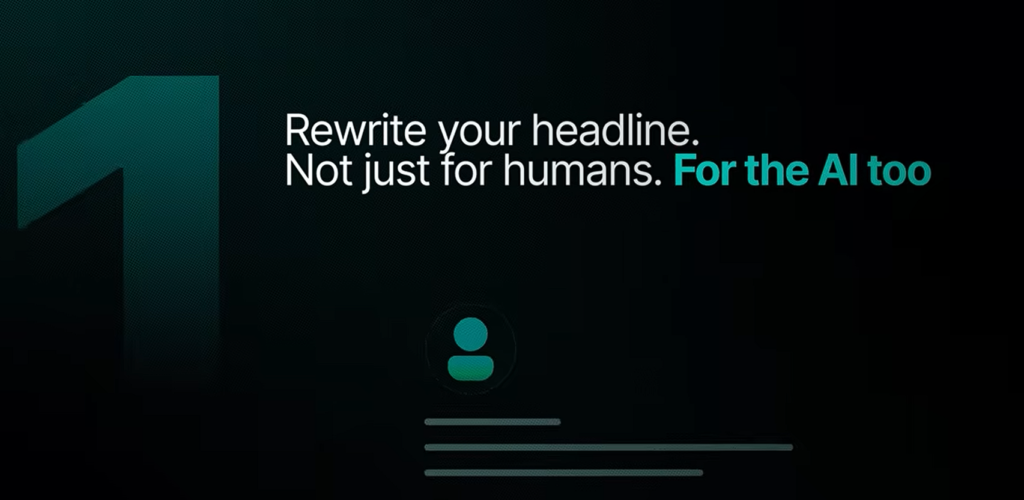
Rule 1. Rewrite your headline for the AI as well as the human
Your headline is one of only five fields that travel with your content into someone else’s feed. The model uses it to work out who should see your post.
A headline that says “thought leader” and “change maker” gives the system nothing to work with. There’s no semantic signal in it, so it can’t match you to anybody.
Your headline needs the words your buyer would use to describe what they need. The more specific your author data, the more accurately the model can put your content in front of the right people.
We had a consultant change two lines of their profile and watch reach jump 226%. Same content, same posting cadence.
Do this today: open your profile, read your headline out loud, and ask whether your ideal client would immediately know you can help them. If the answer is no, rewrite it before you close this tab.
[IMAGE SUGGESTION: side-by-side screenshot of a vague headline vs a specific ICP-language headline]
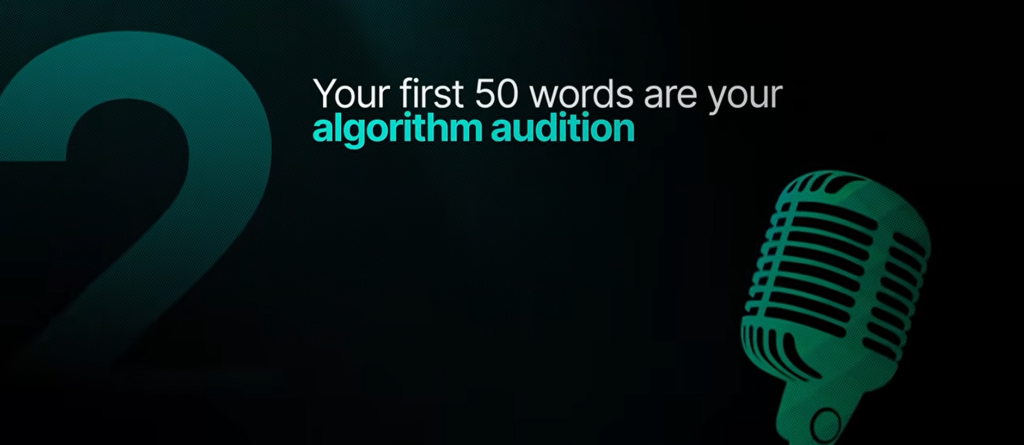
Rule 2. Your first 50 words are the audition
In the model configuration LinkedIn tested, retrieval truncates your post text to the first 60 tokens when deciding whether you make the candidate pool. That’s roughly 45 to 50 words.
Everything after that counts for ranking once you’re already in the pool. The initial filter, the part that decides whether your post gets considered at all, reads the opening.
So your hook is doing two jobs now. It has to stop a human, and it has to give the model enough signal to match you to an audience. Spend those 50 words on setup and slow warm-up and the system has nothing to go on.
Go and check this: pull up your last five posts and count the first 50 words of each one. If those words could sit on top of anyone else’s post in your industry, they’re too generic. Your topic and your reader need to be in the opening line.
Rule 3. Go deep on one topic or stay invisible
The old LinkedIn rewarded breadth. Hot takes, generic advice, anything that could pull engagement from the largest possible number of people. The new system runs the other way.
The engineering blog explains it directly: the LLM uses world knowledge to understand connections between topics that keyword systems couldn’t see. Their example is an electrical engineer who engages with posts about small modular reactors. The old system had no way to link those. The new one understands the relationship between electrical engineering, power grid work, renewable energy and nuclear infrastructure, and makes the jump on its own.
Tim Jurka confirmed the same thing in his post. Exceptional content can be distributed broadly to members interested in the type of content you post, even when they don’t follow you. Every piece of content gets its own path based on topic, format and timing.
Post about everything and the model can’t build a clear picture of you, which makes you unmatchable. Commit to a specific professional topic and the system gets very good at finding the exact people who care about it.
Change this now: look at your last 20 posts and ask whether a model could spot a clear pattern, or whether it would see productivity tips, leadership quotes and industry commentary in a pile. Pick the lane and hold it for 90 days. The algorithm categorises you over time, so give it something clean to work with.
Rule 4. Write posts that earn saves
AuthoredUp ran an analysis on engagement impact across their platform and found one save carries roughly five times the reach impact of a single like.
That tracks with how the new system works. It’s built to find what LinkedIn calls professional interactors, people taking meaningful action rather than scrolling past. A like is the cheapest signal a person can send. A save says they want to come back to this.
Motivational content doesn’t get saved. Tactical content does. Frameworks people can apply, data they can cite, playbooks they can follow, checklists they can open in their next meeting.
Before you publish: ask whether your buyer would bookmark this post or send it to a colleague. If not, add something specific to it. A framework, a set of numbers, a step-by-step breakdown. Give them a reason to hit save.
Rule 5. Early engagement matters, for a different reason now
When LinkedIn first fed raw engagement numbers into the model, the AI treated them like random text. A post with 12,345 views was just digits on a page, and the correlation between popularity and how well the model matched content to people was close to zero.
So they converted everything into percentiles. Instead of raw counts, the system reads “this post sits in the 71st percentile of view counts.” The engineering blog reports that change alone pushed the correlation up 30 times and improved recall by 15%.
Early engagement still matters, because it moves your post into a higher popularity percentile and makes the model more confident about widening distribution. The engagement has to be real. The system reads quality as well as volume.
What I’d do: stop asking friends to drop a like in the first hour. Put that effort into a hook strong enough that the first organic readers actually respond, then reply to every comment inside the first two hours. Real conversation is the signal.
Rule 6. Your engagement history trains your own feed. Use that strategically
The system keeps a time-ordered list of every post you’ve positively engaged with, and it keeps only the positive signals. LinkedIn tested including negative ones, posts you saw and skipped, and the model got worse.
Dropping them cut memory usage by 37%, processed 40% more training data per batch and made training 2.6 times faster. Better results on less compute.
The generative recommender then treats your history as a sequence. Machine learning content on Monday, distributed systems on Tuesday, back on Wednesday, and the system reads that as a professional learning arc rather than three unrelated data points.
Adam Bird’s clarification still stands here. What you engage with shapes your feed, not your reach. Your feed shapes what you notice, and what you notice shapes what you publish, which is the thing the algorithm distributes.
Do this today: engage heavily inside your niche. Like, comment on and save posts from people covering your topic and people who sit in your ICP. You’re training the feed to show you the best thinking in your space and putting you in front of the people you want to sell to.
Rule 7. Pods and engagement bait are being actively killed
LinkedIn’s March 12th announcement says this outright. They’re working to make engagement pods ineffective, curb comment automation and shut down third-party tools that manufacture fake conversation. They’re also reducing repetitive low-substance posts and engagement bait where the caption doesn’t match the content.
The new system tracks dwell time and genuine engagement patterns. It can tell the difference between someone who read your post and left a real comment, and someone who typed “great insight” in two seconds.
I know the counterargument, because I hear it every week. Other creators are doing all of this and their posts look like they’re working. You’re seeing likes and comments. You aren’t seeing their impressions, their reach, or whether any of it turns into revenue.
Change this now: get out of the pod, turn off the comment automation, and drop any post whose only job is to farm distribution. The system is being built specifically to find that behaviour. Build reach on content good enough that you don’t need the shortcuts, because the model keeps getting smarter and shortcut accounts lose first.
Rule 8. Small accounts just got a structural advantage
This is the most counterintuitive finding in the whole rebuild. The A/B data in the retrieval paper shows the new system produced a 3.29% revenue increase for members with fewer connections, and a 1.17% increase in professional interactions. The biggest winners are smaller, newer accounts.
The old system was tilted toward large networks. With 50,000 connections you had built-in distribution through network activity alone. The new one matches content to interest and cares much less about the size of your network.
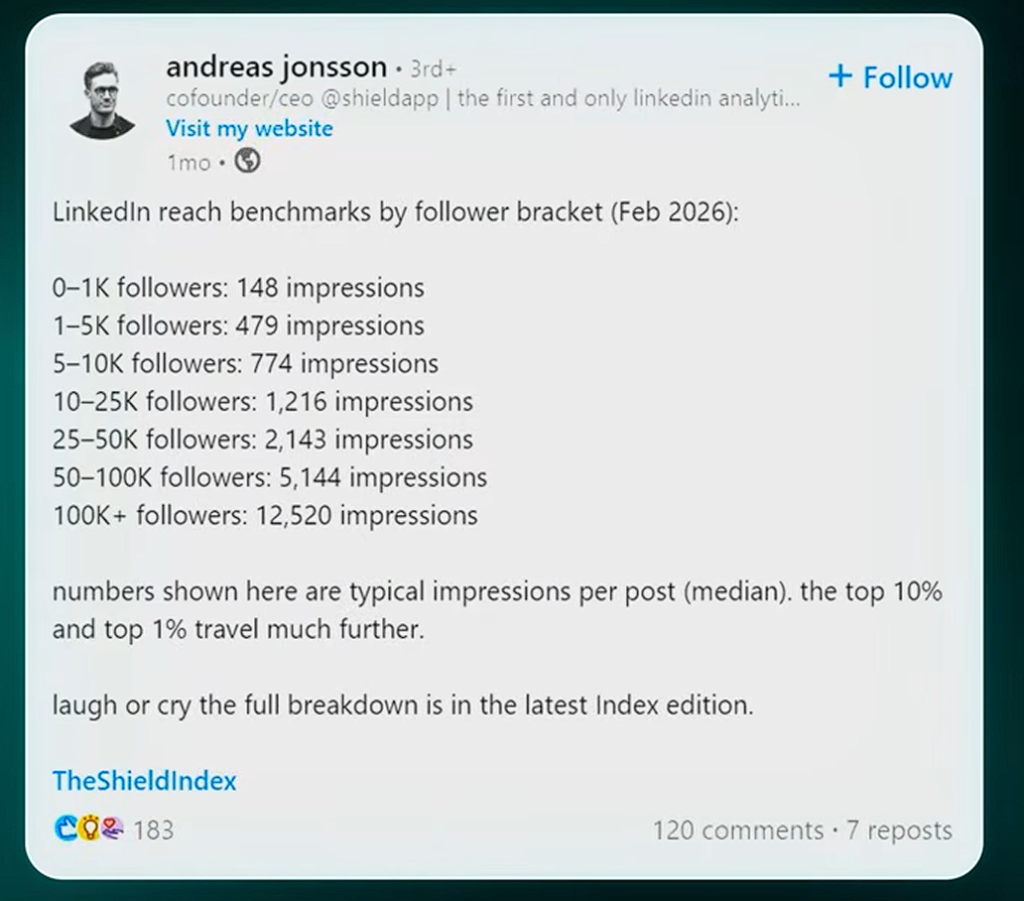
Shield Analytics published February 2026 benchmarks on median impressions per post by follower count:
1K to 5K followers: around 479 impressions
5K to 10K followers: around 774
25K to 50K followers: around 2,143
100K+ followers: around 12,520
Those are medians, so the top 10% and top 1% travel much further than that.
We see it firsthand. One of our clients at Distinctiva has 17,000 followers and generated over 1 million impressions in the last 28 days, reaching 390,000 unique members. Accounts with 100K followers aren’t hitting those numbers. Same platform, same algorithm, different content.
Do this today: if you’ve been waiting to build a bigger audience before getting serious about LinkedIn, start posting. The system was rebuilt in your favour. Go deep on your topic, write things worth saving, and let the algorithm find your audience, because that’s what it was designed to do.
Your eight-point checklist
Rewrite your headline using your ICP’s language.
Check the first 50 words of every post for topic and audience signal.
Pick one topic lane and commit to it for 90 days.
Write posts people save, with frameworks, numbers and steps.
Stop chasing early velocity and focus on real conversation in the first two hours.
Be deliberate about what you engage with in your own feed.
Leave the pods and turn off comment automation.
Start posting now, whatever your follower count says.
What to do with all of this
The algorithm got smarter, the way every platform eventually does, and LinkedIn told us how. The research papers came first, then 360Brew came down, then the engineering blog went up, then Tim Jurka posted publicly, then corporate confirmed the whole thing. Read the sources yourself rather than taking anyone’s word for it, mine included.
People say LinkedIn is dead and reach is gone. At the same time I watch people close deals and land in front of exactly the right buyers every day. Both things are happening on one platform, and the gap between them is whether you understand how the system works and make content worth distributing.
If you want to work through this with other people doing the same thing, that’s what The LinkedIn Engine is for. Live Q&As, bootcamps, and answers on your specific account instead of slides you watch alone.
If you’d rather have it run for you, that’s what we do at Distinctiva. Book a call or send me a DM on LinkedIn and we’ll work out what your content is missing.
I’ll make you a bet. Pull up your LinkedIn profile right now. I can find at least one thing that’s actively suppressing your reach. Not maybe. Every single account we’ve audited has at least one. By the end of this video, you’ll know exactly what it is and how to fix it.
And I’m not guessing. Everything I’m about to show you comes from LinkedIn’s own research papers, their VP of Engineering’s public posts, and an official corporate announcement from two weeks ago. I’m going to give you eight rules, and after each one, I’ll tell you the exact thing to go change right now.
So let’s get into what happened. Earlier this year, LinkedIn started publishing research about their algorithm. One paper described a 150-billion parameter AI model called 360Brew, designed to unify their ranking systems. That paper got taken down from arXiv for licensing reasons shortly after it went up. Then in October 2025, a second paper dropped from LinkedIn’s own team describing a completely rebuilt retrieval system. I made a video breaking that down when it came out.
Then two weeks ago, on March 12th, LinkedIn went fully public. Hristo Danchev, who works on LinkedIn’s flagship AI team, published a deep technical breakdown on the engineering blog. LinkedIn’s corporate communications team put out an official announcement. And Tim Jurka, LinkedIn’s VP of Engineering, who spent 13 years building the feed, posted directly on LinkedIn explaining how it all works.
Between those sources and what we’ve been seeing across client accounts at Distinctiva, the picture is very clear. LinkedIn is rolling out a fundamentally rebuilt system that decides what content you see, and the rules changed.
And to be clear about where this comes from, the retrieval paper was written by LinkedIn engineers, published from their LinkedIn.com emails, describing experiments run on LinkedIn’s actual platform with real A/B test data. Then LinkedIn’s own engineering blog published a companion piece describing the exact same architecture. Then corporate confirmed it’s deployed. These aren’t leaks. These aren’t rumours. LinkedIn published this themselves.
For years, LinkedIn ran multiple separate systems at the same time. One tracked your network’s activity in chronological order. Another handled trending posts by geography. Another ran collaborative filtering based on similar members’ interests. Another tracked industry-specific trending content. And several more ran on embedding-based retrieval. Each system had its own infrastructure, its own logic, and its own biases.
That’s why the old advice worked. Go at 8am. Get your pod to comment immediately. Stuff your post with hashtags. You were gaming individual machines, and it worked because those machines were simple enough to trick.
LinkedIn is replacing those separate systems with a unified retrieval model powered by a fine-tuned large language model, specifically Meta’s Llama 3. And on top of that, they built a new ranking model called a generative recommender that uses transformer architecture to understand how you consume content over time. This isn’t a small update. This is a ground-up rebuild of both how content gets discovered and how it gets ranked, and it changes what works.
Now, before I get into the eight rules, I need to correct something from my last video. A senior AI and machine learning leader named Adam Bird left a comment with two important clarifications, and he’s right. First, not all your profile fields determine whether your post reaches someone else’s feed. Only your author data gets encoded on the content side. That is your name, headline, company, industry, and title. Five fields. The full rich profile, your skills, job history, certifications, languages, is used on the viewer side to understand what they want to see. Second, your engagement with other people’s posts doesn’t affect whether your content reaches someone else. It only shapes what gets served in your own feed.
Those distinctions change what you optimise for. So let’s get tactical.
Rule one. Rewrite your headline, not just for humans, for the AI too. Your headline is one of only five fields that travel with your content into someone else’s feed. The AI uses it to decide who should see your post. So if your headline says random things like “thought leader” and “change maker”, the system has zero semantic signal. It can’t match you to anyone.
Your headline needs to contain the words your ideal client would use to describe what they need. Not what you do necessarily, what they need. The more specific your author data is, the more accurately the AI can deliver your content to the right people.
So here’s what to do right now. Open your profile, read your headline, and ask yourself: if my ideal client saw these words, would they immediately know this person can help me? If the answer is no, rewrite it before you close this video.
Rule number two. Your first 50 words are your algorithm audition. In LinkedIn’s tested model configuration, the retrieval system truncates your post text to the first 60 tokens when deciding whether to include you in the candidate pool. That’s roughly 45 to 50 words. Everything after that matters for ranking once you’re already in the pool. But the initial filter, the part that decides whether your post even gets considered, focuses on the beginning.
So your hook isn’t just for humans. It’s for the AI as well. If you spend your first 50 words on setup, context, or a slow warm-up, the system doesn’t have enough information to match you to the right audience.
So here’s what to do. Pull up your last five LinkedIn posts. Count the first 50 words of each one. Do those words actually contain enough signal for an AI and a human to understand what this post is about and who it’s for? If those first 50 words could belong to anyone in your industry, they’re too generic. Your hook needs your topic and your audience baked into the opening line.
Rule number three. Go deep or go invisible. The old LinkedIn rewarded breadth. Hot takes. Generic advice. Anything that could get the maximum number of people to engage. The new system is the opposite.
LinkedIn’s engineering blog explains this directly. The LLM uses world knowledge to understand connections between topics that keyword systems couldn’t see before. Their example: if you’re an electrical engineer who engages with posts about small modular reactors, the old system couldn’t connect those. The new system understands the semantic relationship between electrical engineering, power grid optimisation, renewable energy, and nuclear infrastructure. It makes those connections through world knowledge.
And Tim Jurka confirmed this in his post. Exceptional content can be distributed broadly across LinkedIn to members who are interested in the type of content you post, even if they don’t follow you. Every piece of content has its own path based on topic, format, and timing.
So if you try to be about everything, the AI can’t build a clear embedding for you. You become unmatchable. But if you go deep on a specific professional topic, the system gets extremely good at finding exactly the right people to show your content to.
So here’s what to do. Look at your last 20 posts. Could the AI identify a clear topical pattern? Or would it see a random mix of productivity tips, leadership quotes, and industry commentary? Pick your lane and commit to it for the next 90 days. The algorithm categorises you over time. Give it something clear to work with.
Now, if you want to run through all of this step by step, I built a free LinkedIn algorithm audit kit that walks you through every rule in this video with checklists and AI prompts you can use to audit your own profile and content. I’ll link it in the description below. Grab that, and let’s keep going, because the next five rules are where it gets really tactical.
Rule four. Write posts that earn saves, not likes. AuthoredUp ran an analysis on engagement impact across their platform and found that one save equals roughly five times the reach impact of a single like. And when you understand how the new system works, that tracks.
The system is optimised to find what LinkedIn calls professional interactors. People who take meaningful actions, not passive scrollers. A like is the lowest-effort signal you can send. A save is high intent. It tells the algorithm this person found so much value they want to come back to it.
So the question is, are you writing content that people want to reference later? Frameworks they can apply, data they can cite, playbooks they can follow, checklists they can use in their next meeting. That’s what earns saves. Motivational content doesn’t get saved. Tactical content does.
Here’s what to do. Before you publish your next post, ask yourself: would my ideal client bookmark this? Would they send it to a colleague? If the answer is no, add something specific. A framework, a set of numbers, a step-by-step breakdown. Give them a reason to hit save.
Rule five. Early engagement can still matter, but not for the reason you think. When LinkedIn first tried feeding raw engagement numbers into their model, the AI treated them like random text. A post with 12,345 views, the model just saw digits. The correlation between popularity and how well the model matched content to the right people was basically zero.
So they converted everything into percentiles. Instead of raw numbers, the system now sees “this post is in the 71st percentile of view counts”. That change alone made the model significantly better at understanding which content was performing well. The engineering blog says the correlation jumped 30 times and recall improved by 15%.
So what does this mean? Early engagement still matters, not because of velocity like the old system, but because it moves your post into a higher popularity percentile, which makes the AI more confident about showing it to a broader audience. But the engagement has to be real. The system is reading quality, not just counting.
Here’s what to do. Stop relying on pods or asking friends to drop a like in the first hour. Instead, focus on writing a hook strong enough that the first organic viewers actually engage, and reply to every comment in the first two hours. Real conversations signal to the system that this post is generating genuine professional interaction.
Rule number six. Your engagement history trains your own feed, so use that strategically. The system maintains a time-ordered list of every post you’ve positively engaged with, and it only keeps the positive signals. They actually tested including negative signals, posts you saw but didn’t engage with, and it made the model worse. Removing negative signals reduced memory usage by 37%, processed 40% more training data per batch, and made training 2.6 times faster. Better results and less compute at the same time.
And LinkedIn built a generative recommender that treats your engagement history as a sequence. When you engage with machine learning content on Monday, distributed systems on Tuesday, and open LinkedIn again on Wednesday, the system understands that as a professional learning journey, not three random data points. It maps your curiosity arc over time.
Now, Adam Bird confirmed that your engagement with other posts doesn’t affect whether your content reaches someone else. This is about your own feed. But your feed shapes what inspires your content, and what you create is what the algorithm distributes.
Here’s what to do. Be intentional about what you engage with. Engage heavily with content in your niche. Like, comment on, and save posts from creators covering your topic area, or people who are in your ICP. You’re training the algorithm to show you the best thinking in your space, which will sharpen what you create and get you closer to the people you actually want to sell to.
Rule number seven. LinkedIn is actively killing engagement bait and pods. This isn’t speculation. LinkedIn’s official announcement on March 12th says it directly. They are working to make engagement pods ineffective and curb comment automation and third-party tools that create fake conversations. They are reducing repetitive, low-substance posts and engagement bait where the caption doesn’t match the content.
The new system tracks dwell time and genuine engagement patterns. It distinguishes between someone who read your post and left a thoughtful comment, versus someone who typed “great insight” in two seconds without actually reading.
So here’s what to do. If you’re in a pod, get out. If you’re using automation tools for comments, stop. If you’re writing posts designed to gain distribution rather than deliver genuine value, understand that the system is now specifically built to identify that and suppress it. Write for humans. The AI is watching whether the humans actually care. Learn how to create organic content that performs well instead of always trying to game the system.
And I know what you’re thinking. You can see other creators doing all of this and their posts look like they’re performing. But you’re only seeing likes and comments. You don’t see their impressions. You don’t see their actual reach. You don’t see whether any of it is converting into business. What you see on the surface doesn’t tell you what’s happening underneath.
Play the long game. Learn how to create organic content good enough that you don’t need to rely on hacks and cheat codes, because the system is only getting smarter, and the people who build their reach on shortcuts are the ones who are going to lose first.
Rule number eight. Smaller accounts just got a structural advantage. This is the most counterintuitive finding. LinkedIn’s A/B test data from the retrieval paper shows that the new system produced a 3.29% revenue increase for members with fewer connections, and a 1.17% increase in professional interactions. The biggest beneficiaries of the rebuild are smaller, newer accounts.
The old system was biased toward large networks. If you had 50,000 connections, you had a built-in distribution network just through network activity. The new system matches content to interest regardless of network size.
Shield Analytics just published their February 2026 benchmarks: median impressions per post by follower count. Someone with 1 to 5K followers gets about 479 impressions. 5 to 10K gets 774. 25 to 50K gets 2,143. And accounts with 100K plus followers get a median of 12,520 impressions per post. These are medians. The top 10% and top 1% travel way further.
And we’re seeing this firsthand. One of our clients at Distinctiva has 17,000 followers, and in the last 28 days he’s generated over 1 million impressions and reached 390,000 unique members. Those are numbers that accounts with 100K followers aren’t hitting. Same platform, same algorithm. The difference is the content.
Here’s what to do. If you’ve been waiting to build a bigger audience before going serious on LinkedIn, stop waiting. The system just got rebuilt in your favour. Start posting now. Go deep on your topic. Write posts worth saving. The algorithm will find your audience for you. That is literally what it was designed to do. You don’t need to be a huge creator to reach the right audience. And honestly, I love that about the new algorithm.
Now, if you’re watching this and thinking “I want to implement this with other people who are doing the same thing”, I’m building a community for exactly that. People who are serious about LinkedIn content strategy and building real authority in their space. And this isn’t just a course where you watch me go through slides and can’t ask questions. This is a space where we get into your specific situation. Personal questions answered, bootcamps, live Q&As, a space to learn how to build organic content correctly, to create content you’re actually proud of, to stop feeling FOMO over huge influencers gaming the system. Because that’s what we’re good at. Organic, genuine content. If you want early access, the waitlist link is in the description.
Okay, this was a lot, so let me bring it all together. The algorithm didn’t get worse, it got smarter, like every social media platform. And LinkedIn told us exactly how. The research papers came first. Then 360Brew got taken down. Then the engineering blog went up. Then Tim Jurka, VP of Engineering, posted publicly. Then corporate put out an official announcement confirming all of it. This isn’t LinkedIn gurus guessing. This is LinkedIn’s own people explaining what they built.
Your checklist. Go do these right now. One, rewrite your headline with your ICP’s language. Two, check your first 50 words on every post. Three, pick a clear topic lane and commit for 90 days. Four, write posts that earn saves, not just likes. Five, stop chasing early velocity and focus on real engagement. Six, be intentional about what you engage with in your own feed. Seven, get out of pods and stop using automation. Eight, start posting now regardless of your audience size.
Every source I referenced is linked in the description. The arXiv paper, the engineering blog, the official announcement, Tim Jurka’s post. Read them yourself. The free audit kit is down there too, with AI prompts to help you run through every rule. If you want us to do this for you, that’s what Distinctiva does. Links in the description, or DM me on LinkedIn.
And look, I see so many people saying LinkedIn is dead, that reach is down, that the platform doesn’t work anymore. And at the same time, I’m watching people build businesses, close deals, and get in front of exactly the right audience every single day. Both are happening on the same platform. The difference is whether you understand how it works and create content worth distributing. Subscribe if you want more of this. I’ll see you in the next one.
Share:
Fresh Insights, Straight to Your Inbox
Get expert tips and strategies to grow your brand with powerful content just by suscribing to our newsletter
I studied 131 hooks from 21 creators growing on LinkedIn right now, and only five formats keep earning the see more click. The dense hook, punchy plus context, the single-line bomb, stacked, and the hybrid you graduate to once the first four are in your hands. Plus the pixel-width rule that makes most hook advice wrong.